Polygonscan is a Polygon PoS Explorer for POL Gas and Tokens
In short: Polygon PoS blockchain explorer for checking transactions, wallet balances, token transfers, smart contracts, and POL gas activity.
Polygonscan is a Polygon PoS block explorer for tracing POL gas payments, wallet activity, token transfers, NFT records, and verified smart contracts in one searchable public ledger. It turns raw on-chain data into readable pages: transaction hashes show status and fees, wallet pages show balances and transfers, token pages show holders and movement, and contract pages show source code when a developer has verified it.
Reading a Polygon transaction from hash to final status
A transaction hash is the fastest route into the explorer. Paste the hash into search and the record shows whether the transaction succeeded, failed, or remains pending. The page also exposes the sender, recipient, block number, timestamp, POL gas used, gas price, nonce, and the method called on a contract. Those fields matter because Polygon PoS activity moves through smart contracts as much as simple wallet -to-wallet transfers.
The status line deserves the first glance. A successful transaction means the network accepted and executed it; a failed transaction means the fee was still paid but the intended state change did not complete. On a swap, bridge action, mint, or approval, the logs and token transfer tabs explain what assets moved after execution. Polygonscan makes those traces readable without requiring a node, command line, or ABI decoding workflow.
Wallet pages show balances, transfers, and contract calls together
Address pages work like public account statements for Polygon PoS. A wallet page lists native POL balance, token holdings, normal transactions, internal transactions, ERC-20 transfers, ERC-721 transfers, and ERC-1155 transfers when those records exist. The same address format covers externally owned wallets and contract accounts, so the account type and transaction behavior help explain what a user is viewing.
This is useful after using a DeFi app, NFT marketplace, gaming contract, bridge, or payment tool. The visible transfer rows separate the gas payment from the asset movement, which prevents a common mistake: assuming the top-level recipient is always the final destination of the token. In smart contract activity, the transfer event tab tells the cleaner story.
POL gas details explain the cost of using Polygon PoS
Polygon PoS uses POL as its native gas token, replacing the former MATIC role for gas on the network. Every submitted transaction consumes gas because validators execute and record the requested action. The explorer records gas limit, actual gas used, effective gas price, and total transaction fee, giving users a concrete view of what the operation cost on-chain.
Those details help compare routine actions. A plain POL transfer uses a simple path, while swaps, NFT mints, token approvals, and contract interactions require more execution. Polygonscan does not decide the fee; it displays the fee data produced by the network so users can audit what their wallet signed and what the chain accepted.
Token pages turn ERC-20, ERC-721, and ERC-1155 activity into records
Token pages gather contract-level data into one place. An ERC-20 page shows transfers, holders, decimals, contract address, and supply information when available. NFT pages track token IDs, ownership changes, metadata references, and collection movement. ERC-1155 records are especially important for games and multi-token collections because one contract can represent many token types.
The transfer history gives a cleaner view than a wallet interface when investigating a payment, mint, reward, or marketplace settlement. It shows the exact contract address and the addresses involved, reducing confusion between lookalike token names. A token symbol is convenient for scanning, but the contract address is the durable identifier on Polygon PoS.
Verified contracts make smart contract pages readable
Contract pages become far more useful when the source code is verified. Verification matches deployed bytecode to published source files, compiler settings, and constructor arguments. Once that match is complete, the explorer displays readable Solidity code and exposes read and write panels for supported contract functions.
Developers use Polygonscan verification after deployment so users, auditors, and integrators can inspect the contract rather than treating it as opaque bytecode. The read panel handles view functions such as balances, limits, ownership fields, or configuration values. The write panel connects through a wallet and submits transactions, so every action still requires wallet confirmation and gas.
Approvals are worth checking after DeFi and NFT activity
Token approvals authorize a contract to move a specific token from a wallet under the rules of that token standard. They are common in swaps, lending markets, NFT marketplaces, games, and bridges. Approval records matter because they persist after the original transaction, and an unlimited approval leaves broader spending permission than a one-time exact allowance.
The token approval checker tied to the explorer gives wallet owners a structured way to review allowances across assets. A user who no longer interacts with a contract can revoke an old allowance by submitting a new transaction that changes the approval state. Revocation costs gas, but it narrows future exposure from stale permissions.
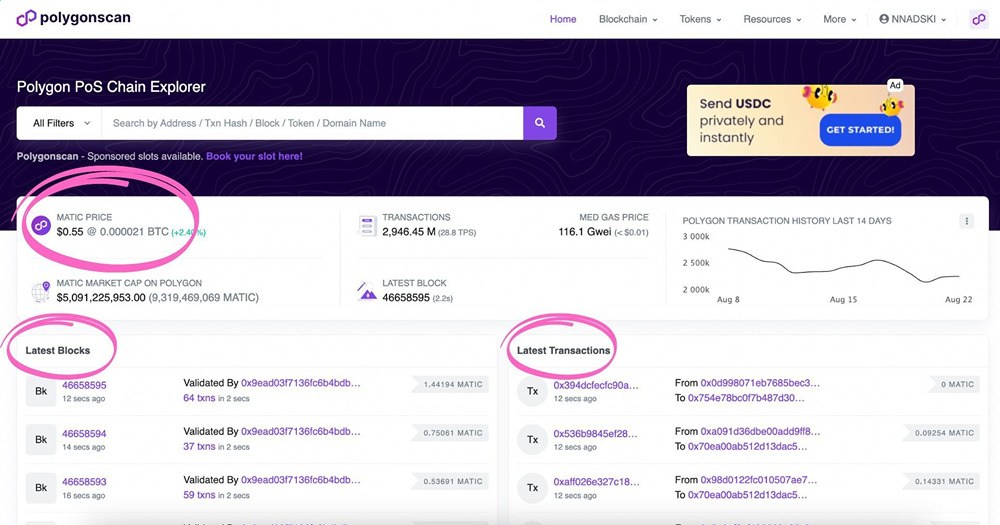
How search works across blocks, accounts, tokens, and names
The search bar accepts transaction hashes, block numbers, wallet addresses, contract addresses, token names, and recognized labels. Exact identifiers produce the cleanest result. A pasted contract address leads directly to the contract page, while a hash leads to a single transaction record. Labels and name tags add context for widely recognized services, contracts, and public entities.
Block pages are useful when timing matters. They show the validator, transaction count, gas used, and neighboring blocks, placing one transaction inside the network sequence. Polygonscan also surfaces charts and analytics for network activity, giving researchers a broader view of usage patterns without downloading chain data themselves.
Builder tools include APIs, contract verification, and event inspection
Application teams rely on explorer tooling during deployment and support. API endpoints expose account, transaction, token, contract, log, and gas-related data for dashboards and backend processes. Event logs help developers confirm that a contract emitted the expected data after a transaction. Verification tools make deployed contracts easier to inspect from wallets, analytics tools, and user support workflows.
These tools complement, rather than replace, direct RPC infrastructure. An RPC endpoint submits and reads chain state at the protocol layer, while Polygonscan indexes that data into searchable pages and developer-friendly responses. Support teams use that index when a user provides a hash, address, or block number and needs a clear explanation of what happened.
Safe use starts with addresses, methods, and wallet prompts
Blockchain explorers are read-heavy tools, so simply looking up a hash or address does not move funds. The higher-risk moment arrives when a page asks a connected wallet to sign a transaction through a write function or approval action. The method name, contract address, token amount, and wallet simulation details deserve attention before confirmation.
Bookmarks help avoid lookalike search results, and hardware wallets add friction before sensitive approvals. For everyday checking, no wallet connection is needed: transaction lookup, token movement, balances, blocks, and verified contract code are public. Connecting a wallet is only necessary for actions such as writing to a contract or changing an approval.
Where it fits next to wallets, RPCs, and other explorers
A wallet shows the owner-facing view of assets and signing prompts. An RPC provider gives applications a path to read from and submit to the network. An indexer organizes large sets of events for analytics. Polygonscan sits in a different role: it is the public inspection layer that ordinary users, developers, support teams, and analysts use when they need a shared record.
Other Polygon ecosystem tools cover portfolio tracking, DeFi analytics, cross-chain bridge status, and contract monitoring. The explorer remains the neutral starting point for checking whether an on-chain action actually landed. When a wallet balance looks wrong or an app screen lags, the transaction record and token transfer logs give the most direct evidence.
What to know about Polygonscan
- Do I need a wallet to look up Polygon transactions?
- No wallet is needed to search public Polygon PoS data. You can paste a transaction hash, wallet address, block number, token contract, or smart contract address and read the indexed record. A wallet connection becomes relevant only when you use a write function, revoke an approval, or submit another transaction that changes on-chain state.
- What does a failed transaction mean on Polygonscan?
- A failed transaction means the network included the transaction in a block, charged gas for execution, and then reverted the requested action. The asset movement did not complete, but the gas fee was still spent because validators processed the attempt. The status, error message, logs, and method field help identify whether the failure came from slippage, permissions, contract rules, or insufficient gas.
- Which address should I trust when checking a Polygon token?
- The contract address is the strongest identifier for a token on Polygon PoS. Names and symbols are easy to imitate, while a contract address points to one deployed token contract. When checking an ERC-20 or NFT, compare the address shown in your wallet, app, or transaction record with the token page before relying on the displayed name.
- Can Polygonscan show NFT transfers as well as token transfers?
- Yes. It indexes ERC-721 and ERC-1155 activity alongside ERC-20 transfers when the relevant events are emitted on Polygon PoS. NFT pages show collection-level records, token IDs, ownership changes, and transfer history. Wallet pages also separate NFT transfers into their own views, which makes marketplace purchases, mints, and game asset movements easier to follow.
- How long does a Polygon transaction take to appear in the explorer?
- A Polygon PoS transaction normally appears after it is broadcast, indexed, and included in a block. The visible status changes as the network processes it and the explorer updates its records. If a wallet shows a submitted transaction before the page loads, searching the exact hash again after a short wait usually reveals the pending, successful, or failed state.
- Why are token approvals visible after I finished using an app?
- Approvals are separate on-chain permissions, not temporary website sessions. When you approve a token spend, the token contract records an allowance for a specific spender address. That allowance stays in effect until it is replaced, reduced, or revoked by another transaction. This is why old DeFi, marketplace, and bridge permissions remain visible after the original app interaction is over.
- Is the POL fee shown the same as the amount I transferred?
- No. The POL fee is the network gas cost paid to execute the transaction, while the transferred amount is the asset moved by the transaction. A POL transfer includes both a transferred value and a fee. A token swap or NFT mint might transfer another asset while still using POL separately to pay for execution on Polygon PoS.