Polygonscan is a receipt reader for Polygon PoS transactions and POL gas
In short: Polygon PoS block explorer that searches transactions, addresses, tokens, and contracts, with POL gas details for everyday wallet checks.
Polygonscan is a practical way to inspect what happened on Polygon PoS after a wallet action, swap, bridge transfer, token approval, NFT mint, or contract call. It turns raw block data into searchable receipts: transaction hashes, wallet addresses, token movements, contract events, timestamps, confirmations, and POL gas costs. The useful angle is simple: when a wallet says something succeeded or failed, this explorer shows the public record behind that result.
Reading a Polygon PoS transaction from top to bottom
A transaction page starts with the status, hash, block number, timestamp, sender, receiver, value, method, and fee fields. That order matters because it separates three different questions: whether the chain accepted the action, who initiated it, and which contract or address received the call. When a DeFi swap, marketplace purchase, bridge claim, or token transfer feels unclear, the receipt is the fastest place to ground the answer.
The method label gives a plain-language clue about the function called by the wallet . A transfer, approval, mint, stake, claim, or swap does not mean the same thing, and the label helps distinguish a normal token movement from a contract permission or a failed interaction. Event logs then show the emitted records underneath the transaction, which is where many token and NFT changes become visible.
Where POL gas appears on a receipt
Gas on Polygon PoS is paid in POL, the current gas token that succeeded MATIC as Polygon moved its token design forward. On a transaction receipt, the fee view combines gas price, gas used, and the final paid amount. That total explains the network cost of the action, separate from the token value transferred or the market price of the asset involved.
Small wallet actions still deserve attention because contract calls vary in complexity. Sending a simple token transfer consumes less gas than interacting with a DEX router, claiming rewards, minting an NFT, or executing a bridge-related call. Polygonscan helps make that difference visible by putting the execution fee beside the transaction outcome rather than hiding it inside wallet history.
Search habits that save time during wallet checks
The search box accepts transaction hashes, public wallet addresses, contract addresses, block numbers, token names, and token tickers. A hash is the cleanest input when a wallet, exchange, bridge, or application gives one after submission. A public address works better when the goal is to review recent activity, inspect token balances, or find an older transaction without remembering the exact hash.
Several checks benefit from a consistent order:
- Search the transaction hash first when a specific action is in question.
- Open the sender address to compare nearby transactions in the same session.
- Review token transfers to separate native POL movement from ERC-20 transfers.
- Check internal transactions when a contract routed value behind the main call.
- Use logs only after the summary fields leave a detail unresolved.
This routine keeps the investigation focused. It also prevents a common mistake: treating a wallet balance change as the whole story when the real action was a contract approval, a routed swap, or an NFT transfer event.
Address pages for balances, approvals, and repeated activity
An address page works like a public ledger profile. It lists native POL balance, token holdings, transaction history, token transfers, NFT transfers, and contract interactions tied to that address. A user checking a personal wallet sees whether funds arrived, which token contract moved, and whether a recent application interaction produced more than one on-chain event.
For contract addresses, the same layout becomes more technical. The page identifies verified contract code when available, shows read and write contract panels, and connects activity to token trackers or protocol usage. Polygonscan becomes especially useful here because many Polygon applications share familiar Ethereum-style standards, while still settling on Polygon PoS with its own blocks and gas market.
Token and NFT movement without relying on a marketplace view
Marketplace pages and wallet galleries present a polished view, but the explorer shows the chain record. Token tracker pages group transfers, holders, contract details, decimals, and supply-related fields when those fields are available from the contract. NFT views show ERC-721 and ERC-1155 movements, making it easier to confirm whether a collectible transferred, minted, burned, or moved through a contract.
This matters when an application interface lags, a collection page does not update, or a wallet hides a low-value token by default. Polygonscan does not need the wallet interface to classify every asset perfectly before showing that a transfer occurred. The receipt and token transfer tables provide the evidence a user needs to reconcile wallet history with public chain data.
Contract tabs for users who need more than a receipt
Verified contracts expose source code, ABI details, and interactive read or write panels. The read side is useful for checking public contract state, such as owner fields, token metadata functions, allowance values, or pool parameters. The write side is more sensitive because it prepares real wallet actions against a contract, so it belongs in workflows where the user already understands the function being called.
Developers use these pages to confirm deployments, inspect constructor arguments, compare bytecode, and support users who report failed actions. Non-developers still benefit from verified contract labels and token pages because they reduce confusion between similarly named assets. A familiar ticker alone does not prove a token is the intended contract; the contract address and transfer history carry the weight.
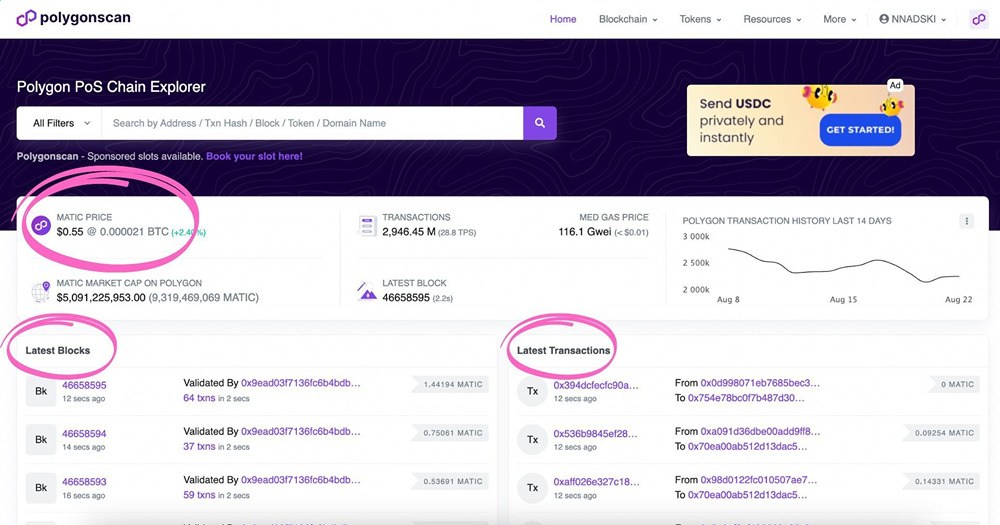
Advanced filters for narrowing noisy histories
Busy addresses quickly accumulate swaps, approvals, bridge transactions, NFT claims, spam tokens, and automated contract calls. Advanced filtering helps narrow that noise by sender, receiver, amount range, age, method, or transaction type. It is especially useful when a wallet has hundreds of entries and the user only remembers that an action happened within a certain day or involved a particular counterparty.
Explorers from the Etherscan family are strongest when the user treats them as investigative tools, not just search pages. Polygonscan follows that pattern on Polygon PoS: a broad address view gives the timeline, filters reduce the search field, and the individual transaction page explains the final execution result.
When another explorer or wallet view gives a clearer answer
Wallet apps are better for signing transactions, managing accounts, and showing a simplified portfolio. Portfolio dashboards are better for valuation, DeFi positions, and cross-chain summaries. Blockscout-style explorers and other Polygon-compatible tools provide alternate indexing and presentation, which helps when one interface is delayed or when a developer wants a second decoded view.
The strength of Polygonscan is the familiar transaction-detail workflow: hash lookup, address history, token tracker, contract verification, event logs, and POL gas accounting in one place. That makes it a dependable first stop after a transaction is submitted and a useful second screen while using wallets, DEXs, bridges, NFT marketplaces, and smart contract tools on Polygon PoS.
A cleaner way to confirm what actually happened
On-chain activity becomes easier to understand when every wallet action is treated as a receipt with fields to inspect. Status answers whether execution completed. The from and to fields identify the path. Token transfer tables show asset movement. Logs reveal contract events. Gas fields show the POL cost of inclusion and execution.
Polygonscan brings those pieces together for everyday checks without asking the user to read raw node data. It is most valuable after something already happened: a pending wallet action, a completed swap, a missing NFT, an unexpected approval, a bridge transfer, or a support request that needs a transaction hash. Used that way, it turns Polygon PoS activity into a record that a normal wallet screen rarely explains in full.
Polygonscan FAQ
- What does a failed Polygon transaction show in the explorer?
- A failed transaction still appears with its hash, sender, target address, block information, and gas spent. The status field marks the execution as failed, while the method and logs help explain where the call stopped. POL gas is still paid because validators processed the attempted transaction even though the contract state change did not complete.
- Which fields matter most when checking a token approval?
- The important fields are the spender contract, the token contract, the method name, and the amount or allowance recorded by the contract. A token approval is permission, not a token transfer by itself. Reviewing the approval transaction beside later transfer activity helps distinguish a harmless setup step from an allowance that later enabled token movement.
- Can Polygonscan show NFT transfers from Polygon marketplaces?
- Yes. NFT transfers that settle on Polygon PoS appear through ERC-721 or ERC-1155 transfer records when the underlying contract emits standard events. Marketplace pages add collection context and pricing, while the explorer shows the chain-side movement: token ID, contract address, sender, receiver, transaction hash, and timestamp.
- Why does a wallet balance differ from the explorer balance?
- Differences come from delayed wallet indexing, hidden tokens, unsupported token metadata, pending transactions, or a wallet showing a portfolio estimate rather than the exact chain record. The explorer reads indexed public activity for the address, while wallets apply their own display rules. Checking native POL, token transfers, and the token holder page usually reveals the mismatch.
- Recovering a missing transaction hash after closing the wallet popup?
- Search the sending wallet address and sort recent activity by time. The transaction list should show the newest outgoing contract calls, transfers, or failed attempts from that address. If the wallet submitted the transaction successfully, the hash appears in that timeline even if the application page or popup was closed before saving it.